Structural Drying in Emeryville, CA
Structural drying pulls water out of framing, subfloor, drywall and concrete, not just the surface. The drying team sets air movers and LGR dehumidifiers to the evaporation load and keeps them running until readings reach the dry reference.
(888) 774-9605Plan the dehumidifier setup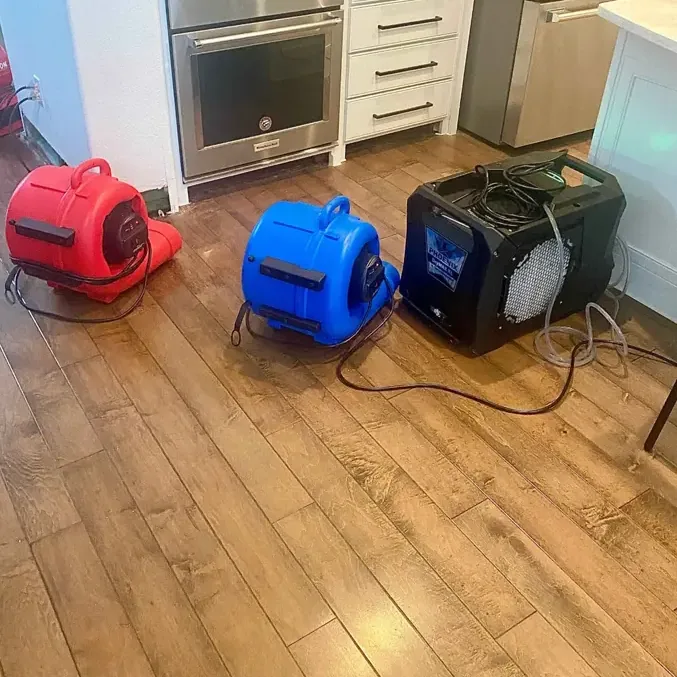
Water that soaks into a building does not leave when the floor looks dry. It sits in the subfloor, the bottom of the drywall, the framing and the concrete, and it keeps evaporating into the room for days. Structural drying is the measured process that pulls it out. It follows the IICRC S500 standard: map the moisture, size the equipment to the class of loss, take readings every day and stop only when the materials match a dry reference.
First steps for structural drying and dehumidification right now
- Stop the water source. Drying cannot work while water still comes in, so stop the leak or the inflow first.
- Get standing water out. Extraction comes before drying; every gallon removed saves hours of dehumidifier time.
- Keep the space closed. Keep windows shut and the heat at normal room temperature so the equipment can work.
- Leave equipment running. Do not switch off air movers or dehumidifiers between readings, even overnight.
How structural drying and dehumidification is handled, start to finish
Map and class
The tech maps moisture in every wet material, takes a dry reference reading and sets the class of loss, which decides how much equipment each room needs.
Set the equipment
Air movers, LGR dehumidifiers and, where needed, desiccants, floor mats or cavity drying go in, sized to the evaporation load of each room.
Read and adjust daily
The drying team takes daily temperature, humidity and moisture readings, moves equipment to the slowest areas and logs every number.
Confirm dry
Equipment comes out when readings are within 2 to 4 points of the dry reference, and the final numbers close the claim file.
What makes drying harder here
Buildings near San Francisco Bay sit in marine air, and many stand on concrete slabs over fill: the Judson Steel land was developed on waste and construction debris brought from San Francisco in the early 1900s, near the old Emeryville Mudflats.
- Concrete slabs in ground-floor units and shops off 40th Street and Stanford Avenue hold water for days
- Stacked condos at Watergate mean drying two or three units at once
- Plaster and older dense materials in industrial-era buildings release water slowly
- Hardwood and engineered floors need careful, slower drying to avoid cracking
The EPA indoor air quality pages explain why controlling indoor moisture matters for the people living or working in the space.
How structural drying is set up
Drying is planned from readings, not from a stock number of fans.
- Moisture mapping of every wet wall, floor and ceiling, plus a dry reference reading
- Class 1 to 4 set from how much and how deep water soaked in
- Air movers aimed along wet walls and floors; LGR dehumidifiers sized to the room
- Desiccant dehumidifiers, floor mats or cavity drying for dense materials
Every day the drying team takes temperature, humidity and moisture readings, moves equipment where it is needed and removes it as each area reaches the goal.
Keep the heat on and the windows shut
During drying, a closed space at normal room temperature lets the dehumidifiers work. Open windows on a damp day can slow drying instead of speeding it up.
Water out but the walls and floors still read wet? Call now and the Emeryville drying team sizes air movers and dehumidifiers to the loss and the building.
☎ Book the dehumidifiersInsurance and the drying record
Adjusters look for proof that drying was needed and that it worked. The claim file holds the moisture map, the class of loss, the equipment list, daily psychrometric logs and the final dry readings. Coverage depends on your policy, so check with your own insurer.
Drying in occupied buildings
Many drying jobs here happen in occupied condos, offices and shops. Equipment is placed to keep exits and walkways clear, and power is planned so circuits are not overloaded in older buildings.
What does structural drying and dehumidification cost in Emeryville, CA?
Structural drying typically runs $1,200 to $8,000, set by the class of loss, the number of rooms and how long equipment has to run to reach the dry goal.
Class 1 or 2, one area
- A few rooms
- Air movers and an LGR
- Three to five days
Class 3, several rooms
- Walls wet high
- Several dehumidifiers
- Daily readings
Class 4 or several units
- Concrete, plaster, hardwood
- Desiccants or floor mats
- Extended drying
Ranges are typical, not a quote: the category of water, square footage, material class and how fast drying started move the number most. Run the water damage cost calculator for a closer range.
What a real dry-out involves here
Rapid local response
Dispatch runs 24/7, and active water in a condo, loft or office is treated as urgent at any hour, with extraction gear sized to the building.
IICRC S500 drying standard
Structural drying, not just surface drying: air movers and LGR dehumidifiers run to the evaporation load and stay until readings say dry.
Claim-ready documentation
Moisture maps, daily psychrometric logs and timestamped photos taken before any demolition go into one file for the adjuster and the HOA.
Emeryville water experts
Stacked units, older industrial shells, fill near the bayshore and tidal storm drains: the local restoration pros read how water moves here.
Structural drying and dehumidification across Emeryville and the East Bay
Emeryville Water Damage Restoration covers ZIP 94608 and 94662, from the Watergate condos at the marina and the Bay Street and Powell Street corridors to the lofts and homes off San Pablo Avenue, 40th Street and Park Street.
Nearby coverage reaches Berkeley, Oakland, West Oakland, Piedmont, Orinda, San Pablo, Tiburon.
Related water damage services
Structural Drying and Dehumidification questions in Emeryville, CA
What is structural drying?
It is drying the building itself, framing, subfloor, drywall and concrete, to a measured goal, not just drying the surface. It follows the IICRC S500 standard.
How do you know when it is dry?
Readings in the wet materials are compared with a dry reference reading of the same material. Drying is done when they are within 2 to 4 points.
How long does structural drying take?
A Class 1 or 2 loss usually dries in three to five days. Class 3 and Class 4 losses with dense materials can take a week or more.
Why are there so many air movers?
Each air mover moves air across a set area of wet surface. The number comes from the class of loss and the square footage, so the evaporation rate matches what the dehumidifiers can remove.
Can I turn the equipment off at night?
Please do not. Drying works around the clock, and switching off resets progress and can let water move deeper into materials.
What is a desiccant dehumidifier?
It removes moisture with a drying material instead of a cold coil, which works better for dense materials and cooler spaces, often used on Class 4 losses.
Is structural drying covered by insurance?
Drying after a covered water loss usually is part of the claim. Coverage depends on your policy, so check with your own insurer; the daily logs support the claim.
Does bay air slow drying in Emeryville?
Damp outdoor air does not help, which is why windows stay closed and LGR dehumidifiers control the indoor air. The readings, not the weather, decide when drying is done.
Wet walls or floors in Emeryville? Drying starts 24/7
Air movers and dehumidifiers sized to the loss, with daily readings until the building is dry.
(888) 774-9605Start the drying equipment today