Ceiling Leak Water Damage in Piedmont, CA
A stained or sagging ceiling means water is trapped above. In larger older houses an upstairs leak can travel into rooms below, so the drying team opens the ceiling, releases the water and dries the joists.
(888) 774-9605Check the ceiling and joists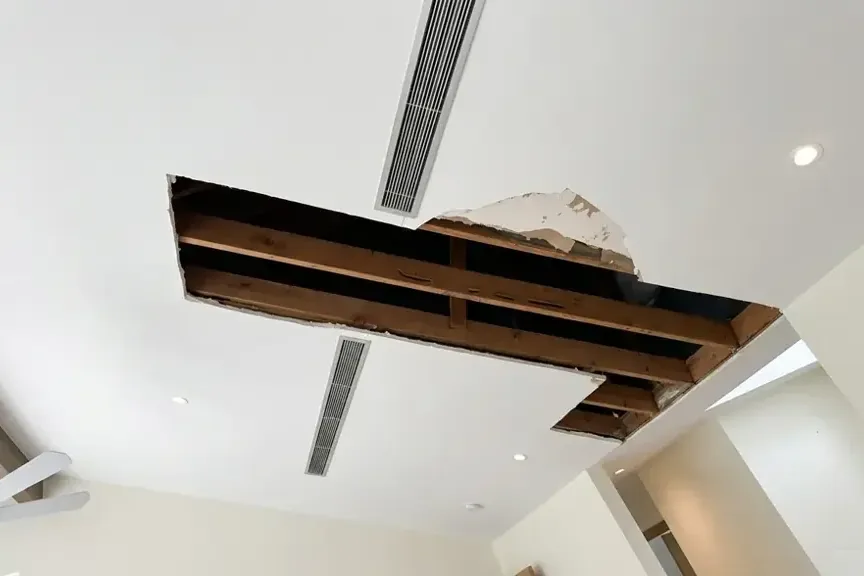
Many Piedmont homes date from the 1920s and 1930s, and in a larger older house an upstairs leak can travel through floors and ceilings into rooms below. A ceiling stain is only the visible end of the problem. The water that made it can sit in insulation and between joists, and it can bring down drywall if it is not released. Wet ceilings can also hide electrical fixtures, so the area is treated with caution.
First steps for ceiling leak water damage right now
- Clear the room. Move furniture and rugs from under the stain and keep everyone out of the area.
- Release trapped water. If a ceiling bulges, a small hole lets the water drain into a bucket before the board gives way.
- Stop the source if known. Close the valve to an upstairs fixture or stop using it until a plumber has checked.
- Photograph and call. Take pictures of the stain and call the drying team to open, dry and document the ceiling.
How ceiling leak water damage is handled, start to finish
Assess and release
The crew checks how much water is trapped and releases it safely, then maps the damp area with meters.
Trace the source
Meters and thermal images show where the water came from, such as a pipe above, a tub or the roof. Each step is photographed for the file and the claim.
Remove and dry
Wet insulation and drywall are removed, and air movers and dehumidifiers dry the joists and cavity.
Verify and record
Readings and photos are logged and shared with the adjuster once the area is fully dry.
Why ceilings need quick attention
Drywall soaked with water gets heavy and soft. A bubble on the ceiling means water is pooling, and a sag means the board has begun to fail. Releasing the water in a controlled way prevents a sudden collapse and keeps the damage from spreading across the room.
- Bubbles or brown rings that grow after rain or fixture use
- Drips from light fixtures, vents or seams
- Soft or sagging drywall that shifts when pressed
- Paint that peels or blisters near a ceiling edge
Keep people out of the room until the ceiling has been checked and the water released.
Opening, tracing and drying
The crew cuts a small opening where water has collected, lets it drain and then follows the moisture with meters to find the source. Wet insulation and drywall are removed, and the joists and cavity are dried with air movers.
- Controlled release of trapped water into a container
- Meters and thermal images that trace the water back to the source
- Removal of insulation and drywall that cannot dry in place
- Air movers and dehumidifiers until the cavity reaches a dry range
The source might be a supply pipe, a drain, a tub or toilet above, or a roof, and each one has its own repair trade. Telling the crew when the stain first appeared helps narrow the search.
Check the floor above
If the ceiling is under a bathroom, kitchen or laundry, the floor above is usually wet too. Tell the crew which rooms sit overhead so those materials are included in the dry-out.
A wet ceiling can fail without warning, and the crew can explain how to stay safe while the area is checked.
☎ Talk to the crewInsurance and ceiling claims
Adjusters want to know the source, the date and the extent of the damage. Photograph the stain before any cutting, note when it first appeared, and keep the plumber or roofer's report together with the cleanup logs. Receipts for any emergency work belong in the same folder.
What does ceiling leak water damage cost in Piedmont, CA?
Ceiling leak drying runs from $800 for a small stain to $15,000 where dirty water or several units are involved, with the price depending on how much drywall and insulation is wet.
Small stain
- Spot opened and checked
- Insulation dried well
- Paint prep ready
Ceiling and walls
- Drywall removed and replaced
- Wall cavities dried
- Joists dried too
Dirty water or several units
- Contamination steps
- Multiple rooms
- Detailed records
Ranges are typical, not a quote: the category of water, square footage, material class and how fast drying started move the number most. Run the water damage cost calculator for a closer range.
What a real dry-out involves here
Rapid local response
Dispatch runs 24/7, and active water in a condo, loft or office is treated as urgent at any hour, with extraction gear sized to the building.
IICRC S500 drying standard
Structural drying, not just surface drying: air movers and LGR dehumidifiers run to the evaporation load and stay until readings say dry.
Claim-ready documentation
Moisture maps, daily psychrometric logs and timestamped photos taken before any demolition go into one file for the adjuster and the HOA.
Emeryville water experts
Stacked units, older industrial shells, fill near the bayshore and tidal storm drains: the local restoration pros read how water moves here.
Ceiling leak water damage across Piedmont and nearby cities
Ceiling leak work covers Piedmont homes from Alta Piedmont and The Highlands to the Highland Avenue and Exedra area, Blair Park, Dracena Quarry Park, Linda Avenue, Hampton Road, Sunnyside Avenue and Craig Avenue.
The same service nearby: ceiling leak water damage in Emeryville, Berkeley, Orinda.
Related water damage services nearby
Ceiling Leak Water Damage questions in Piedmont, CA
Is a ceiling stain an emergency?
It can be. A stain that grows or sags may hold trapped water, and releasing it prevents drywall from collapsing. A growing stain is the clearest warning.
Should I poke a hole in a bulging ceiling?
A small hole over a bucket relieves pressure, but only if it is safe. Stay clear of the area and avoid electrical fixtures. Wear eye protection if you must work near it.
Where does the water come from?
Common sources are supply pipes, drains, tubs and toilets above, appliances and the roof. A moisture trace points to the right one.
Can an upstairs leak reach several rooms?
Yes. In a larger older house, water can travel along joists and through walls into rooms below the leak. Moisture mapping shows the full path.
Will the ceiling need replacing?
Soaked or sagging drywall usually does. Small stains over dry material may only need paint after the cavity has dried.
How long does a ceiling dry-out take?
Typically several days, depending on how much insulation and drywall was wet and the airflow in the cavity. Open cavities dry faster than closed ones.
Does insurance cover a ceiling leak?
Sudden leaks are often covered, but slow ones may not be. Ask your insurer and keep the source repair report.
Can a ceiling leak damage the light fixtures?
Yes. Water can collect in fixtures and wiring, so leave them off and have an electrician check anything that got wet.
Release the water before it falls
Tell the crew where the stain is and what sits above it, and the drying plan is ready when work begins.
(888) 774-9605Plan the ceiling dry-out